Welcome aboard to the our video site for sailors. We are being constantly blasted by scammers and pirates, so registration is invite only
contact@sailorsahoy.com with "Invite". No spam, no newsletters. Just a free account



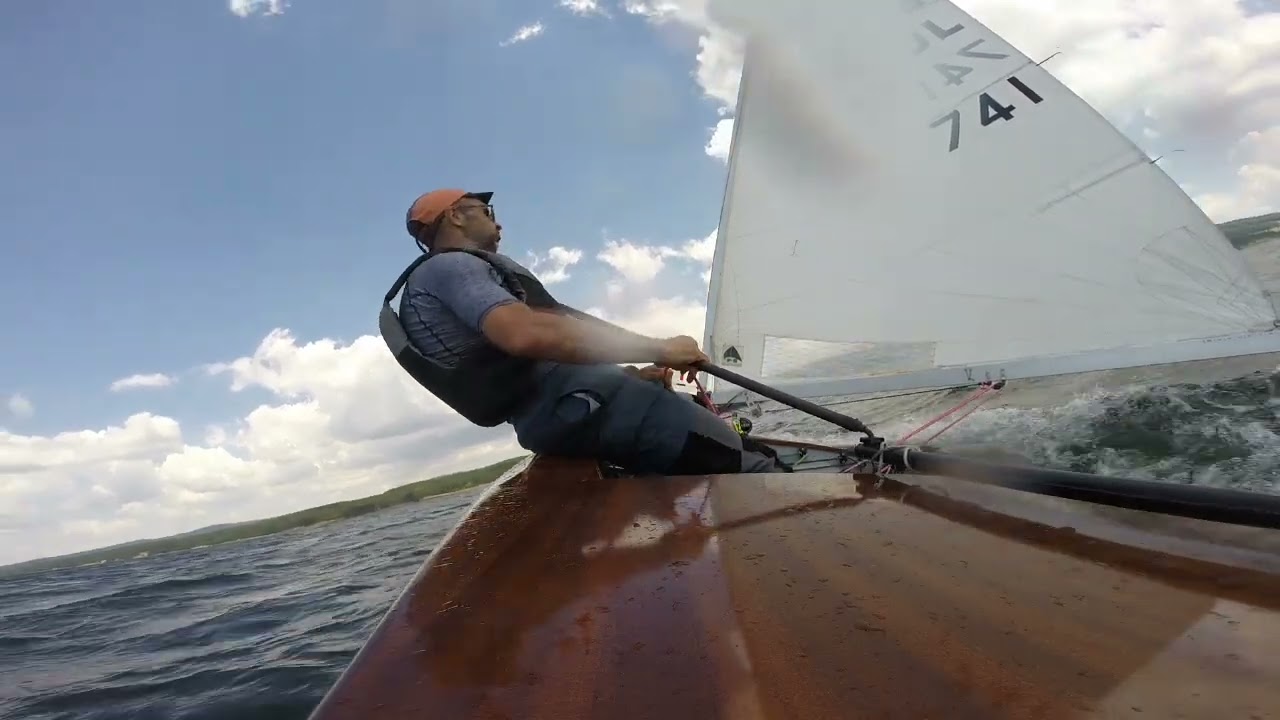




Vareo dinghy sailing under spinnaker 2021

Back to my roots - dinghy racing in Plymouth As most of you know, I have been a professional yacht designer for over 45 years. However I always consider myself to be a sailor first and a designer second. Although I have done a lot of ocean cruising and racing, certainly over 50,000 miles, my real passion is dinghy sailing and - especially - dinghy racing. Indeed, one of the main reasons for leaving N. America and returning to the UK was the lack of dinghy racing in both the US and Canada. I thought this would be an appropriate time for a dinghy sailing post, as it's now 60 years since I first sailed a dinghy single handed. In that time I've sailed most hiking singlehanders (I don't much like trapezing, and since leaving college have rarely known anyone who would dinghy sail with me) In the past, at the extreme end, I've sailed: International 10sqm Canoe, Contender, several "lowrider" International Moths and a Blaze. Plus Europe, OK, Solo etc and of course I've raced Laser and Sunfish. More recently it's been a Byte, Moth, RS Aero and now a RS Vareo. The Vareo was designed over 20 years ago and was one of the first singlehanders to be fitted with an asymmetric spinnaker. So it has a 8.8sqm mainsail (94sqft) plus a 10sqm spinnaker (107sqft). 200sqft of sail area in any wind is hard work when singlehanded and challenging to gybe (which you have to do quite often, since it's an asymmetric spinnaker and thus cannot be sailed dead downwind), but great fun especially in 10 knots of wind under spinnaker when it flies past many nominally faster boats! Clearly, with a mainsheet, tiller and spinnaker sheet to hold, there aren't many hands left for adjusting the kickingstrap (which needs doing every few minutes), cunningham, outhaul and daggerboard. Fortunately I still have all my teeth which helps at times! Of course there's also a LOT of rope in the cockpit, all made slightly more complicated as the spinnaker sheets and kickingstrap are endless, as is the spi halyard/downhaul/pole in-out. Naturally every rope is a different colour, otherwise the "knitting" would be impossible to untangle. As I'm now approaching 70 I'm obviously getting less agile and it also doesn't help to be well under the 90kg optimum weight for a Vareo. However that hasn't stopped me having some success. I was 3rd in the Vareo Nationals (and first Grand Master) and second overall in the 2021 Travellers Trophy. The heading photo shows me leading the fleet at the Inland Championships. 5 minutes later I sailed round the wrong mark and that was that..... I'll probably race the Vareo a couple more years, so this video is just a taster, with more to come once the racing season is underway (first club race is in a weeks time!). Two races a week (sometimes more) from early February to late November. That's very different to the 1960s when few people sailed in the winter and Easter was traditionally the time for the first race. And that's mainly because of better clothing (comfortable wetsuits and drysuits) but also because dinghies are now more reliable and pretty much unbreakable (eg metal not wood masts) and safer (better built in buoyancy, self bailers, transom flaps or, better still, an open transom). Todays popular racing dinghies (Enterprise, GP14, Fireball, Hornet, 505, Finn, Solo, OK etc) were all designed between 1945-65. They are safer now, even though the one design hulls and rigs are the same. In fact the "dangerous" boats today are the classic daysailing cruising dinghies that haven't made similar improvements. I mean the open deck ones, with little buoyancy and no way of easily removing water after a swamping or capsize. A Mk1 Firefly from 1948 is far more dangerous than a modern GRP Firefly despite having the same one design hull. The Mk1 had so little buoyancy that after a capsize the boat was so full of water that the water surface was above the top of the centreboard, so water would leak in almost as fast as you could bail it out with a bucket (been there done that!). See below for more on small boat safety https://www.sailingcatamarans.com/index.php/articles/41-general-articles-technical/477-capsize-demos-talk-at-wbf I'm still considering developing a home build plywood design on similar lines to the Vareo, but for now I just have my 14ft Zest as a home build racing dinghy. More on that here https://www.sailingcatamarans.com/index.php/designs-2/46-beach-cats-and-dinghies/436-zest and video here https://www.youtube.com/watch?v=VnQo_ZuKvag which is of the one we built in two days (the build started Friday morning, the video shows me sailing it Sunday lunchtime.) And of course more of my other videos here https://www.youtube.com/user/WoodsDesigns Thanks to drone expert Chris for the video