Welcome aboard to the our video site for sailors. We are being constantly blasted by scammers and pirates, so registration is invite only
contact@sailorsahoy.com with "Invite". No spam, no newsletters. Just a free account
شلوار کوتاه ایجاد کردن
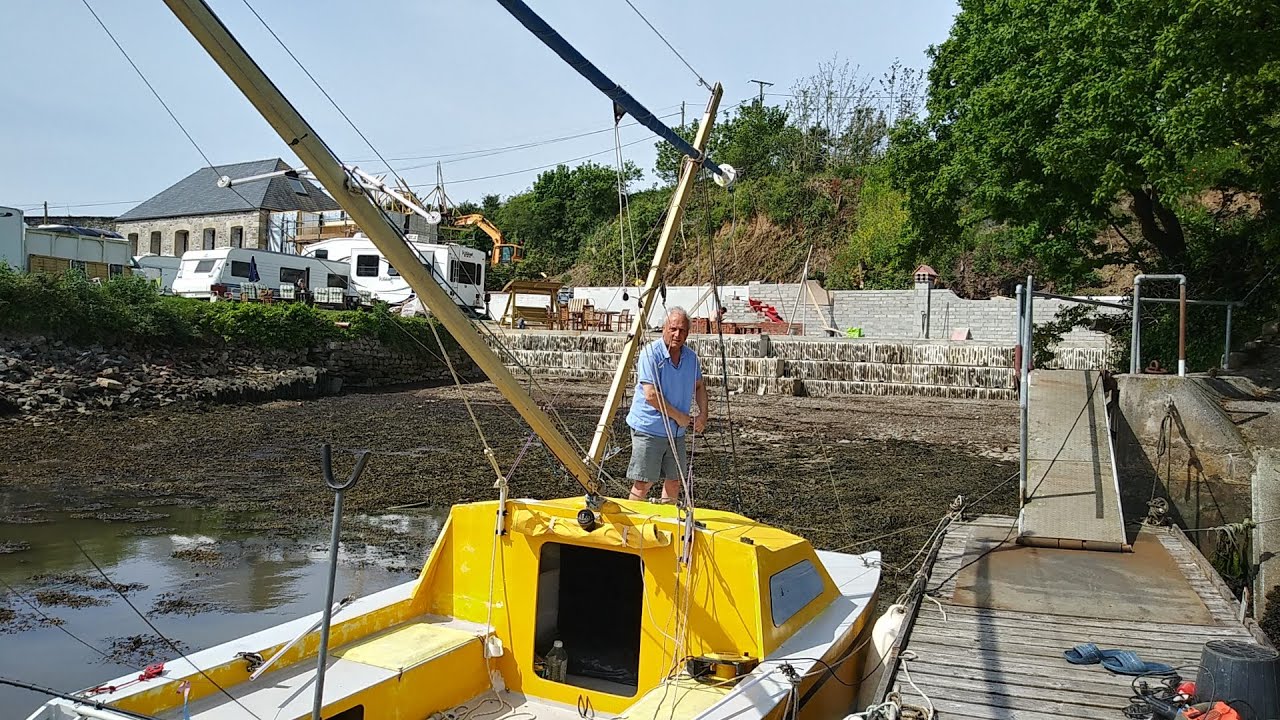
Mast raising without a crane sounds a daunting prospect but it is actually very straightforward if you prepare properly. Some years ago I wrote an article which you can see here, https://www.sailingcatamarans.com/index.php/articles/11-technical-articles/268-safe-mast-lowering-method so this is really just an update. This video shows my Chat 18, which has a mast from a beach cat, and thus one that could be pushed up by hand, but here I show the system that works on any size mast - the biggest I have raised this way was on a 50ft ketch. The key features are a good tabernacle, a "gin pole" - in this case the boom - and most important, the use of temporary shrouds thus ensuring that the mast cannot fall sideways. These shrouds must have "chainplates" that line up exactly with the tabernacle pivot bolt. When down the mast rests on a, eg, dinghy trailer mast support at the back of the cockpit. If you regularly raise you mast you can fit a trailer roller to the bracket, so it's easy to push the mast to and fro for trailering. The "gooseneck" for the ginpole is a shroud adjuster from my junk box, suitably bent and screwed to the front of the mast. Roller reefing gear has to be kept straight and has a tendency to catch on the cabin roof etc. So I always lash it to the ginpole in about the right position. The "chainplates" for the temporary shrouds are, again, from my junk box and are 25mm OD aluminium tubes that clip into place and are easily removed. They also take guywires from the forward end of the ginpole to stop that falling over. I attached the spi halyard to the ginpole, but you can just rely on the forestay/furling gear. The mast is then raised up using the mainsheet shackled to the forestay chainplate (you may need a longer rope, depending on your boat). 4:1 is easy on small boats, on bigger boats lead it back to a winch. Of course the most load is when the mast is horizontal, you often have to push on the mast when lowering to get it to start moving. So if you can get it off the support you know you can hoist it all the way. So it all seems a lot of ropes and preparation but it's all worth it as the mast cannot fall and you always have total control, even in a cross wind. And you can usually raise the mast singlehanded. If you are only occasionally raising/lowering the mast then the temporary stays can be rope. Make a loop in the end and pass it over the spreaders and round the mast using a boathook or, on bigger boats, a bosun's chair. Easy to pull off again afterwards. Before sailing always check the mast with binoculars or camera to ensure there are no twisted shackles or, especially, T bar terminals (which is why I don't recommend T bars on trailable boats.) Use tape or elastic band to hold the stays in the correct position while hoisting - both will break away as the shrouds tighten.

0
0
0
2,246

► Full test in Multihulls World N197: https://www.multihulls-world.com/review/catamaran/gp70-and-then-cruising-became-fantastic ► This racy catamaran designed for fast blue water cruising was initially intended for series production by a well-known shipyard at La Grande-Motte, but ultimately, the project has been taken on by Trimarine, based on the Tagus River near Lisbon, Portugal. The GP70, built with 80% epoxy carbon sandwich, manages to limit its displacement to 17.5 t. This large multihull was designed to offer a very high level of self-sufficiency thanks to low consumption of onboard equipment, a large surface area of solar panels (3 kWp), an efficient watermaker and two imposing 264 US-gallon (1,000 liter) fuel tanks. Under sail, the GP 70 promises exceptional performance and the bridgedeck clearance guarantees excellent seakeeping behavior in big seas. ► TECHNICAL SPECIFICATIONS Builder: Trimarine Naval Architect: VPLP Overall length: 68’11” (21 m) Beam: 32’ (9.75 m) Draft: 5’3” (1.6 m) Air draft: 90’ (27.45 m) Light displacement: 38,580 lbs (17.5 t) Upwind sail area: 2,380 sq ft (221 m²) Engines: 2 x 80 kW Yanmar JH4 Fuel: 2 x 264 US gal (2 x 1 000 l) Water: 290 US gal (1,100 l) ► Become a FREE SUBSCRIBER to Multihulls World's YouTube page now - https://www.youtube.com/c/MultihullsWorld ► Log on to our website to discover over 500 multihulls tests! Subscribe to our newsletter to take advantage of our promotions and boat show invitations! https://www.multihulls-world.com/ ► Follow us on Facebook! https://m.facebook.com/MultihullsWorldMag/?locale2=fr_FR ► Discover us on Instagram! https://www.instagram.com/multihulls_world/ ► Follow our multi news on X https://twitter.com/multihullsworld?lang=fr ► Let’s talk about business https://www.linkedin.com/company/multicoques-mag-multihulls-world/ ► Like us on TikTok! https://www.tiktok.com/@multihullsworldmag #gp70 #tiktok #youtube #boatlife #boat #multicoque #boatreview #multihull #multihullsworld #catamaran #multicoquesmag #francoistregouet #ims #internationalmultihullshow #lagrandemotte @vplpdesign #vplp

0
0
0
461

0
0
0
592


0
0
0
805
0
0
0
0
747

Ever had that jaw-dropping moment when you're just diving and chilling, and out of the blue, a squad of #fish swims by, leaving you in utterly mesmerized? It's like a living painting unfolding right before your eyes! And hey, if you're lucky enough to have someone capture that moment of you on video, that's a pure treasure right there! So, ready to dive into your own incredible #underwater adventures? Join us on board; save your spot now! ✉️ info@LaGaligoLiveaboard.com 💬 +62 812 2000 2025 (WhatsApp) 🌐 www.LaGaligoLiveaboard.com 🌐 Trip.LaGaligoLiveaboard.com (Schedule & Rates) ~~~~ #scubadiving #scuba #diving #diver #liveaboard #divetrips #sea #ship

0
0
0
46