Welcome aboard to the our video site for sailors. We are being constantly blasted by scammers and pirates, so registration is invite only
contact@sailorsahoy.com with "Invite". No spam, no newsletters. Just a free account
السراويل القصيرة خلق
En esta Parte 1 de nuestra serie de preguntas y respuestas, nuestro equipo de Boatjump revela sus destinos favoritos para una aventura en el mar. 🌍🚤 ¿Coincidirán con los tuyos? ¡Dale play y descúbrelo! 🎥⚓ #Boatjump #Navegación #Destinos #AlquilerDeBarcos

0
0
0
19

0
0
0
0
557

0
0
0
39
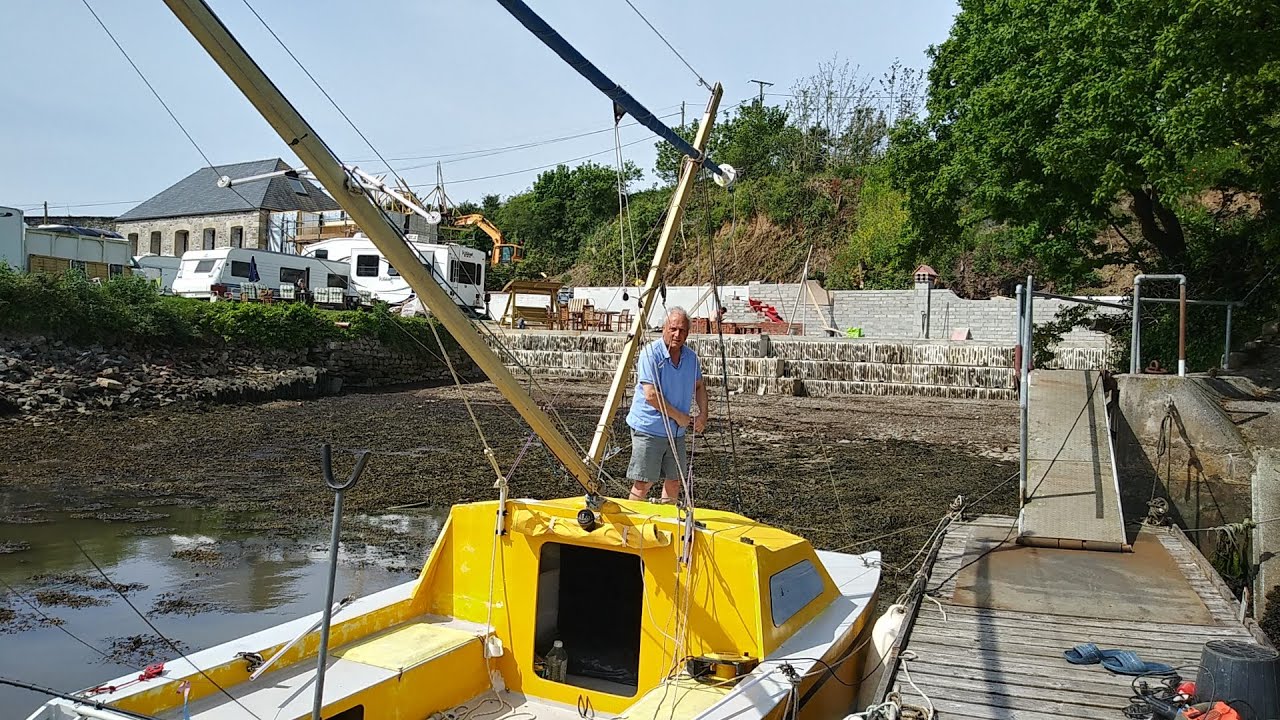
Mast raising without a crane sounds a daunting prospect but it is actually very straightforward if you prepare properly. Some years ago I wrote an article which you can see here, https://www.sailingcatamarans.com/index.php/articles/11-technical-articles/268-safe-mast-lowering-method so this is really just an update. This video shows my Chat 18, which has a mast from a beach cat, and thus one that could be pushed up by hand, but here I show the system that works on any size mast - the biggest I have raised this way was on a 50ft ketch. The key features are a good tabernacle, a "gin pole" - in this case the boom - and most important, the use of temporary shrouds thus ensuring that the mast cannot fall sideways. These shrouds must have "chainplates" that line up exactly with the tabernacle pivot bolt. When down the mast rests on a, eg, dinghy trailer mast support at the back of the cockpit. If you regularly raise you mast you can fit a trailer roller to the bracket, so it's easy to push the mast to and fro for trailering. The "gooseneck" for the ginpole is a shroud adjuster from my junk box, suitably bent and screwed to the front of the mast. Roller reefing gear has to be kept straight and has a tendency to catch on the cabin roof etc. So I always lash it to the ginpole in about the right position. The "chainplates" for the temporary shrouds are, again, from my junk box and are 25mm OD aluminium tubes that clip into place and are easily removed. They also take guywires from the forward end of the ginpole to stop that falling over. I attached the spi halyard to the ginpole, but you can just rely on the forestay/furling gear. The mast is then raised up using the mainsheet shackled to the forestay chainplate (you may need a longer rope, depending on your boat). 4:1 is easy on small boats, on bigger boats lead it back to a winch. Of course the most load is when the mast is horizontal, you often have to push on the mast when lowering to get it to start moving. So if you can get it off the support you know you can hoist it all the way. So it all seems a lot of ropes and preparation but it's all worth it as the mast cannot fall and you always have total control, even in a cross wind. And you can usually raise the mast singlehanded. If you are only occasionally raising/lowering the mast then the temporary stays can be rope. Make a loop in the end and pass it over the spreaders and round the mast using a boathook or, on bigger boats, a bosun's chair. Easy to pull off again afterwards. Before sailing always check the mast with binoculars or camera to ensure there are no twisted shackles or, especially, T bar terminals (which is why I don't recommend T bars on trailable boats.) Use tape or elastic band to hold the stays in the correct position while hoisting - both will break away as the shrouds tighten.

0
0
0
2,234

Easily two of Indonesia's most iconic snorkeling destinations wrapped up nicely in 60 seconds.

0
0
0
1,578

#DoubleTrapeze #iFLY15 #Foiling double in the trapeze with the i'FLY15 for the first time with coach. Nice review : Philip Walker, recreational / family sailor from Switzerland, Lake Murten: « As a mid-40 year-old with 3 young children, a busy life, moderate fitness, some past but no recent sailing and windsurfing experience, but absolutely no catamaran experience; I watched the same iFly15 youtube videos you have, I eyed the price tag and then for a long while I just sat there on the fence with excuses. When was I really going to find the time to sail the thing, was this not just an expensive mid-life crisis toy, was I even going to be able to sail it, how was I going to get it out of the harbour without crashing, could I right it if I capsized, what if I could not control it? The indecision was my comfort zone, not taking the plunge into the unknown was in my safe place. And then I finally took the plunge, I deserved something for me, and those youtube videos just looked like too much damn fun! Still feeling like this could be an expensive mistake, Michael came to assemble the boat, and to be honest gave me a crash course in all things catamaran. We went out on the water together, the two of us out on the trapeze, and for several glorious runs we foiled, I was immediately hooked! Several weeks later came the tough part, just me, 11-15 knots of wind, white caps, and my iFly15. The excuses and fears came back. Last time it was easy, but that was all Michael, he isn’t here now, this time it was just me. Apprehension, fear, the unknown. I followed the steps in setting the boat up, got the boat out without incident and despite my fears multiple foiling runs, out on the trapeze, speed, whining sound of foils in the water, the full monty! I capsized once and that was not because of being overpowered it was because I lost my footing, and righting the boat went smoothly and without incident. The secret of the iFly15 is it is a highly technical machine made to be easy to sail and incredibly accessible. It is compact with not too much sail area and it is very easy to take the power out of the sail and to comfortably sit in an upward position and catch your breath. Safe and in control, on my first day alone out on the water I finally understood what a great boat this is, and I absolutely love it! »

0
0
0
1,865