close

Welcome aboard to the our video site for sailors. We are being constantly blasted by scammers and pirates, so registration is  invite only


contact@sailorsahoy.com with "Invite". No spam, no newsletters. Just a free account

Cortos crear

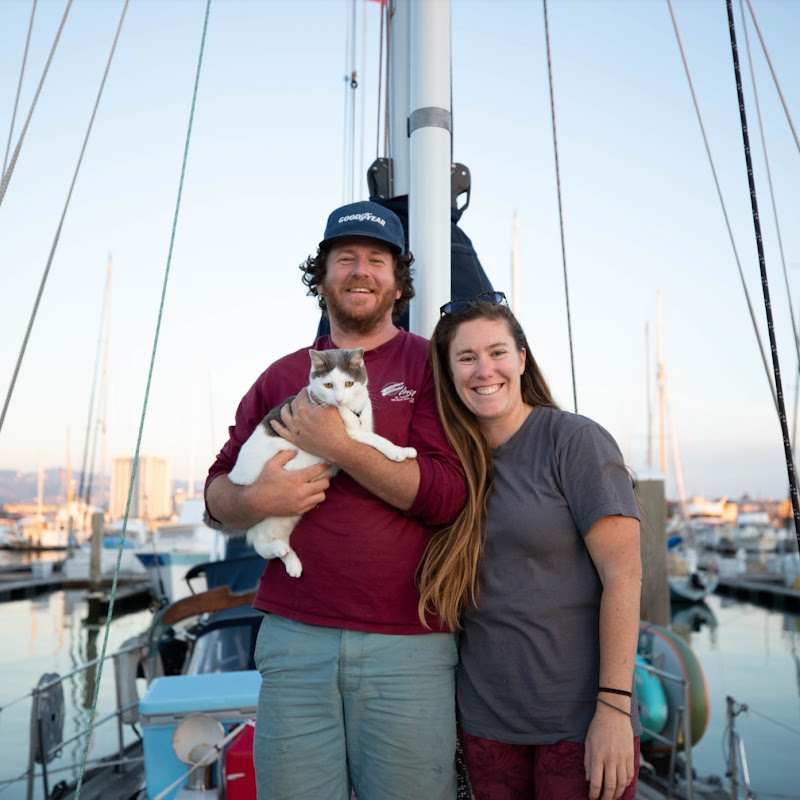
Gemini is our full-time sailboat home while we travel the world, one anchorage at a time. Subscribe to our main channel @twothehorizon for full-length vids and more! Check out our store: https://stan.store/twothehorizon #shorts #sailinglife #boatlife #sailingcouple #nomadlife
twothehorizonsailing-extras

0

0

645

An Bord einer Segelyacht ist es entscheidend, dass alle Gegenstände sicher verstaut sind – ob aufgehängt, verzurrt oder eingeklemmt. Im heutigen Short zeige ich dir, wie das praktisch funktioniert, damit bei Wellengang nichts verrutscht. 👉 Mehr Tipps und komplette Onlinekurse zum Sportbootführerschein findest du auf https://www.segelnag.com

segelnag

0

0

24

1) Understanding your energy needs is essential to determine how much solar you need. Start by making an "energy budget". List all your consumers and their daily usage. For example, if your LED lights use 1W per bulb and you have eight bulbs on for 5 hours a day, that would be 8 Watts for 5 hours or (8x5) 40 Wh (Watt hours). I like to use kWh to keep things consistent. 40 Wh = 0.040 kWh. It's a good idea to list what you're using while at anchor and another list of what you're using while underway (for instance, you don't use your autopilot at anchor). Remember to list everything: fridge, freezer, watermaker, autopilot, nav lights, chart plotters, etc. For example, here aboard Athena, with an electric galley, fridge, freezer, watermaker, two computers, etc, we use an average of 5.5 kWh per day. 2) To give you a quick estimate, use https://globalsolaratlas.info/ to find "Global horizontal irradiation" per day for your location. Take your daily energy consumption from step 1 and divide that by the number of solar hours. In the case of Athena, located in the Caribbean, that would be 5.5kWh per day / 5 sun hours = 1.1 kW solar array. Keep in mind that this is a theoretical number that does not take into account the shading or degradation of the panels over time. Let's add 30%. 1.1 x 1.3 = 1.43 kW. You can now divide that number by the panel's Nominal Power output. In the case of Athena, our panels are 400W SunPower panels. 1430W / 400W = 3.6 panels needed to cover our 5.5 kWh per day consumption. 3) Understand that the amount of solar you can install on a small sailboat is limited by the size of the boat and heavily influenced by shading and, of course, the boat's location. The size of the panels might also be defined by the height of your stanchions or the size of an existing solar arch. Figure out where you're able and willing to install panels. That will dictate the size and number of panels. 4) Use Victron Energy's MPPT Calculator to calculate what MPPT is ideally sized for your solar panels and expected output based on location. Based on our experience in the Caribbean, the estimate provided by the guide is reasonable. https://www.victronenergy.com/mppt-calculator. Remember that it's best practice to avoid combining panels with different specs on the same MPPT. #sailboat #sailboatproject #boatwork #saillife #liveaboard #liveaboardlife #saltlife #sailing #sailingadventure #travel ingcouple #livingonaboat #solar #sailboatsolar

Saillife

0

0

18,950

Launch season is underway at Lyman-Morse. A few of our favorite classic beauties are lining the docks this morning. Take a look at all that brightwork! From beginning to end: Hood 57 by Lyman-Morse, 70' Hinckley, 65' Royal Huisman daysailer, 38' Lyman-Morse jetboat and a Wilbur downeast lobster boat.

lymanmorse

0

0

1,363

Hey guys, I’ve just finished editing this reel/video - which took surprisingly long to edit since I had to squeeze 21 days on the hard into a 1-minute video! 🤪🙈😅 Of course, this video only covers the surface; I’ll go into more detail when I’m uploading the long-format YouTube episode. 😅 As you can see, I’ve decided to repaint my whole boat since I didn’t like the old paint at all. It was grey, there were darker patches everywhere to cover up who knows what, and the YouTube logo that the previous owner painted on was something I just didn’t want on my boat since I personally like simple and clean lines. So now, Sirocco looks brand new and has her name neatly sitting on the bow and stern, and I added my home port of Berlin to the stern of my boat as well, which I’m very proud of (and just realized that I didn’t film the stern at all). 🙈🤪😂 The other jobs included not only the cleaning of the propeller or the new antifoul - I actually had to strip down the old antifoul completely back to the gel coat, to be able to check out a potential patch of delamination that my surveyor informed me about when he surveyed my boat. Unfortunately, the delamination was confirmed by a fiberglass and gel coat mechanic that I hired in Grenada. He actually found another big area of gel coat that was damaged on my keel - which probably happened when the previous owner hit the ground (and promised me that he had it fixed professionally but it didn’t look that way). The mechanic then fixed it and applied the brand new antifoul - so it was altogether way more expensive than the usual annual haul out (and took triple as long as planned) but it had to be done and I’m happy about the results! What do you think - doesn’t Sirocco look fabulous now? 😉🥰⛵️ Cheers guys, Kristina

sailorgirl.kristina

0

0

2,068

PLEASE SUBSCRIBE, LIKE, COMMENT, AND SHARE!!!

sailingislandrhythmadventu7690

0

0

29