Latest videos

Why do ships have two radars? Ship radar systems on large merchant ships usually include an X-band radar and an S-band radar. X-band radar works at 9 GHz (3 cm wavelength) and S-band radar works at 3 GHz (10 cm wavelength). The difference between X-band and S-band radar affects radar resolution, radar beam width, small target detection, rain clutter and sea clutter. How does ship radar work? Marine navigation radar sends a pulse, receives the echo and shows range and bearing on the radar display. X-band radar vs S-band radar: X-band gives a sharper radar picture and better detection of small targets, buoys and coastline. S-band radar performs better in heavy rain and rough seas with less rain clutter and sea clutter. Only X-band radar triggers a radar SART (search and rescue transponder). SOLAS radar requirements: X-band radar on ships of 300 GT and passenger ships, a second radar (normally S-band) on ships of 3,000 GT and above. This video is for entertainment purposes only. #marineradar #xbandradar #sbandradar
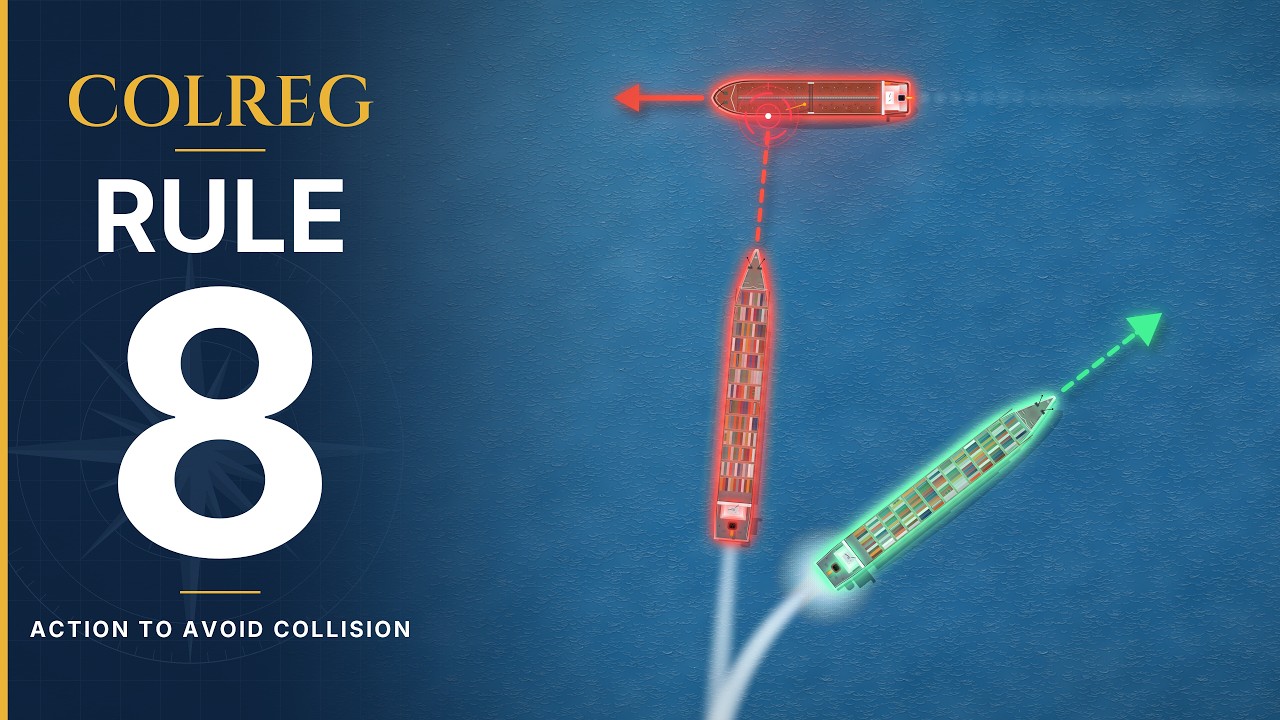
COLREGs Rule 8, Action to avoid collision, explained clause by clause with true-to-scale animation from the bridge, on the radar and from above. How do you avoid a collision at sea — when to act, how much to alter course, and how to know it worked? Rule 7 decides whether risk of collision exists. Rule 8 sets the standard for the action itself. In this video we go through the International Regulations for Preventing Collisions at Sea (COLREGs / IRPCS) Rule 8 paragraph by paragraph: (a) positive action, in ample time, in accordance with the steering and sailing rules; (b) an alteration of course and/or speed large enough to be readily apparent visually and on radar — and why a succession of small alterations should be avoided; (c) alteration of course alone when there is sufficient sea room, without creating another close-quarters situation; (d) passing at a safe distance and checking the effectiveness of the action until the other vessel is finally past and clear; (e) slackening speed, stopping or reversing to avoid collision or gain time; (f) the duty not to impede in narrow channels and traffic separation schemes, and why a vessel not to be impeded still has to follow the steering rules. 0:00 Rule 8 — Action to avoid collision 0:17 (a) Positive, in ample time, in accordance with the Rules 1:17 (b) Large enough to be readily apparent 2:17 (c) Alteration of course alone, with sufficient sea room 3:01 (d) Pass at a safe distance — check until past and clear 3:51 (e) Slacken speed, stop or reverse 4:22 (f)(i) Not to impede — take early action 5:19 (f)(ii) Approaching too late — the duty does not disappear 6:17 (f)(iii) Not to be impeded is not a right of way ⚠️ For general information and entertainment purposes only — not a substitute for the official COLREG text, approved training or professional advice. #COLREGs #Rule8 #Seamanship

The whole hull of a ship gets thick coats of paint and protective coatings — yet the huge propeller is often left bare. Why? To answer that, we follow the engineering path from plain steel to stainless steel, manganese bronze and finally nickel-aluminium bronze — and look at cavitation erosion, marine fouling and why antifouling paint doesn't survive on a propeller blade. For entertainment purposes only. #MarineEngineering #MerchantNavy #ShipPropeller
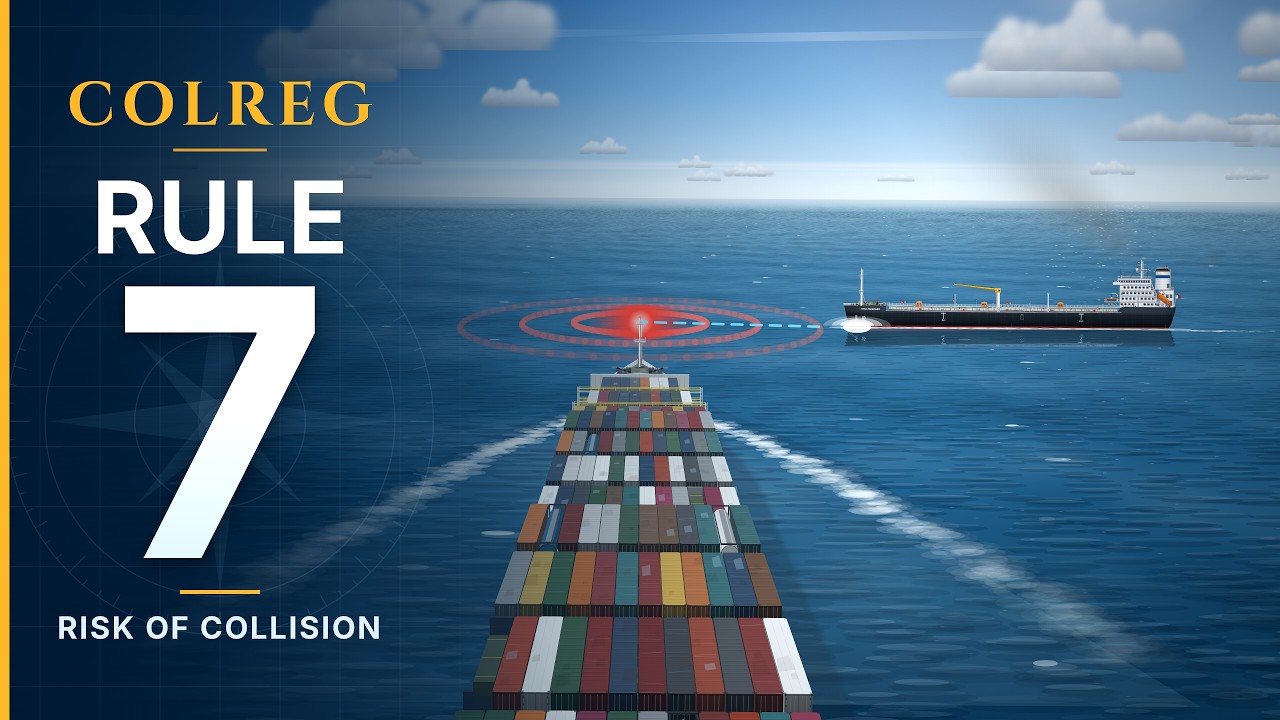
How do you decide whether risk of collision exists — and what if you are not sure? COLREGs Rule 7 explained clause by clause: all available means, radar scanning and plotting, scanty information, and the compass bearing test, shown with true-to-scale animation from the bridge, on the radar and from above. Every give-way and stand-on rule applies only once risk of collision exists, so Rule 7 comes first. In this video we go through the International Regulations for Preventing Collisions at Sea (COLREGs / IRPCS) Rule 7 paragraph by paragraph: (a) using all available means — eyes, binoculars, compass bearings, radar, AIS and sound signals — and treating any doubt as risk; (b) proper use of radar, long-range scanning for early warning and radar plotting / ARPA; (c) why assumptions must not be made on scanty information; (d)(i) steady compass bearing with decreasing range, and why a relative bearing is not enough; (d)(ii) when risk exists even with an appreciable bearing change — very large vessels, tugs and tows, and close range. ⚠️ For general information and entertainment purposes only — not a substitute for the official COLREG text, approved training or professional advice. #COLREGs #Rule7 #Seamanship

What is a safe speed at sea, and who decides it? COLREGs Rule 6 explained: every factor of safe speed in the International Regulations for Preventing Collisions at Sea (COLREGs / IRPCS), shown with true-to-scale animation from the bridge. There is no speed limit in the rules of the road at sea. Instead, Rule 6 asks every officer of the watch one question: can I still take proper and effective action to avoid collision, and stop within the distance the situation allows? In this video we walk through the rule clause by clause — the six factors every vessel must consider (visibility, traffic density, manoeuvrability, background light at night, wind, sea and current, draught and depth) and the six extra factors for vessels with operational radar (equipment limitations, range scale, clutter, small targets, number of targets, and judging visibility by radar). 0:00 No speed limit at sea — why Rule 6 matters 0:17 What the rule says 0:35 Two tests: can she act, can she stop? 0:57 "At all times" 1:13 The factors — six for every vessel 1:27 (a)(i) State of visibility 1:42 (a)(ii) Traffic density 1:56 (a)(iii) Manoeuvrability — stopping distance and turning ability 2:23 (a)(iv) Background light at night 2:44 (a)(v) Wind, sea, current and navigational hazards 3:04 (a)(vi) Draught and available depth — squat 3:23 Six more factors for vessels with radar 3:38 (b)(i) Radar limitations — blind sectors and minimum range 3:56 (b)(ii) Range scale in use 4:17 (b)(iii) Sea state, weather and interference — clutter 4:34 (b)(iv) Small vessels and ice not detected 4:55 (b)(v) Number, location and movement of targets 5:10 (b)(vi) Assessing visibility by radar ⚠️ For general information and entertainment purposes only — not a substitute for the official COLREG text, approved training or professional advice. #COLREGs #Rule6 #Seamanship
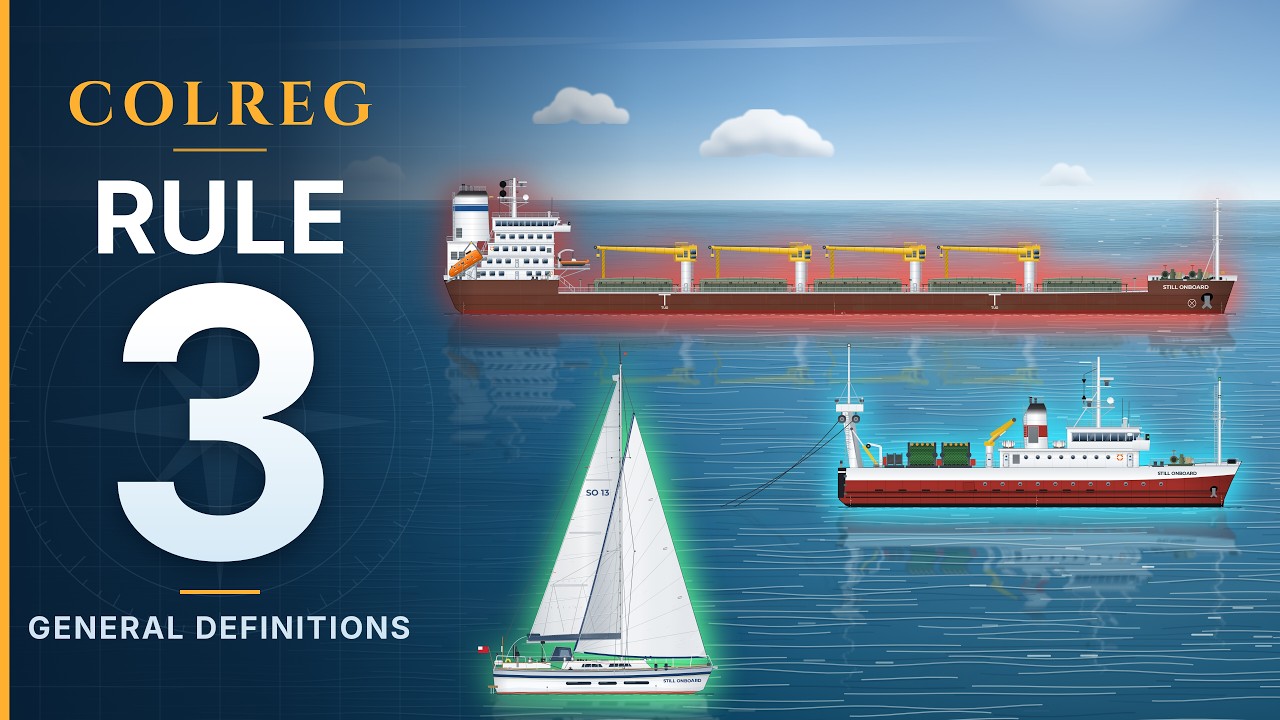
How do the COLREGs define every vessel at sea? COLREGs Rule 3 explained: all 13 general definitions of the International Regulations for Preventing Collisions at Sea (COLREGs / IRPCS), shown with true-to-scale animation. Every rule of the road at sea depends on what kind of vessel you are looking at and what she is doing right now. Who gives way, which lights and day shapes she shows, what she must do in restricted visibility — all of it starts with Rule 3. In this video we go through each definition one by one: what counts as a vessel, a power-driven vessel, a sailing vessel, a vessel engaged in fishing, a seaplane, a vessel not under command (NUC), a vessel restricted in her ability to manoeuvre (RAM), a vessel constrained by her draught (CBD), what "underway" really means, length and breadth, vessels in sight of one another, restricted visibility and WIG craft. ⏱ Chapters 0:00 Why the definitions matter 0:22 "Except where the context otherwise requires" 0:35 (a) Vessel 0:54 (b) Power-driven vessel 1:08 (c) Sailing vessel — and motor-sailing 1:34 (d) Vessel engaged in fishing — and why trolling doesn't count 2:09 (e) Seaplane 2:29 (f) Vessel not under command (NUC) 2:57 (g) Vessel restricted in her ability to manoeuvre (RAM) 3:50 (h) Vessel constrained by her draught (CBD) 4:41 (i) Underway — and making way 5:05 (j) Length and breadth 5:20 (k) In sight of one another — radar contact vs visual 5:45 (l) Restricted visibility 6:04 (m) Wing-in-ground (WIG) craft 6:35 Summary Disclaimer: for general information and entertainment purposes only. Not a substitute for the official COLREG text, approved training or professional advice. #COLREGs #Rule3 #Seamanship

What's inside a ship's liferaft? Every SOLAS life raft carries one sealed survival pack — here is every item in it, why it's there, and how to use it. When a ship is lost, the liferaft opens on its own. Inside, under the canopy, is one bag. For 25 people, it may be everything they have until someone finds them. We open the SOLAS A pack item by item — from the first minutes after abandoning ship to the long wait for rescue. In this video: • The four immediate actions: Cut, Stream, Close, Maintain • Safety knife, rescue quoit, paddles and sea anchors • Bailer, sponges, topping-up pump and leak repair kit • Seasickness pills, thermal protective aids, first-aid kit • Rocket parachute flares, hand flares, smoke signals, torch, signalling mirror, whistle, radar reflector • Water and food rations — and the "no water, no food" rule • Fishing kit and survival instructions • SOLAS A pack vs SOLAS B pack: why some ferry liferafts carry no food or water PART 1 - ▶ Why Liferafts Don’t Sink With the Ship? https://www.youtube.com/watch?v=j3YPCp_-MkU PART 2 - ▶ How Is a Liferaft Built – and Why Is Every Detail There? https://www.youtube.com/watch?v=preraqGaY9s&t Based on the SOLAS Convention and the IMO LSA Code. This video is for general education — on board, always follow your ship's procedures and the manufacturer's instructions. #liferaft #SOLAS #maritimesafety
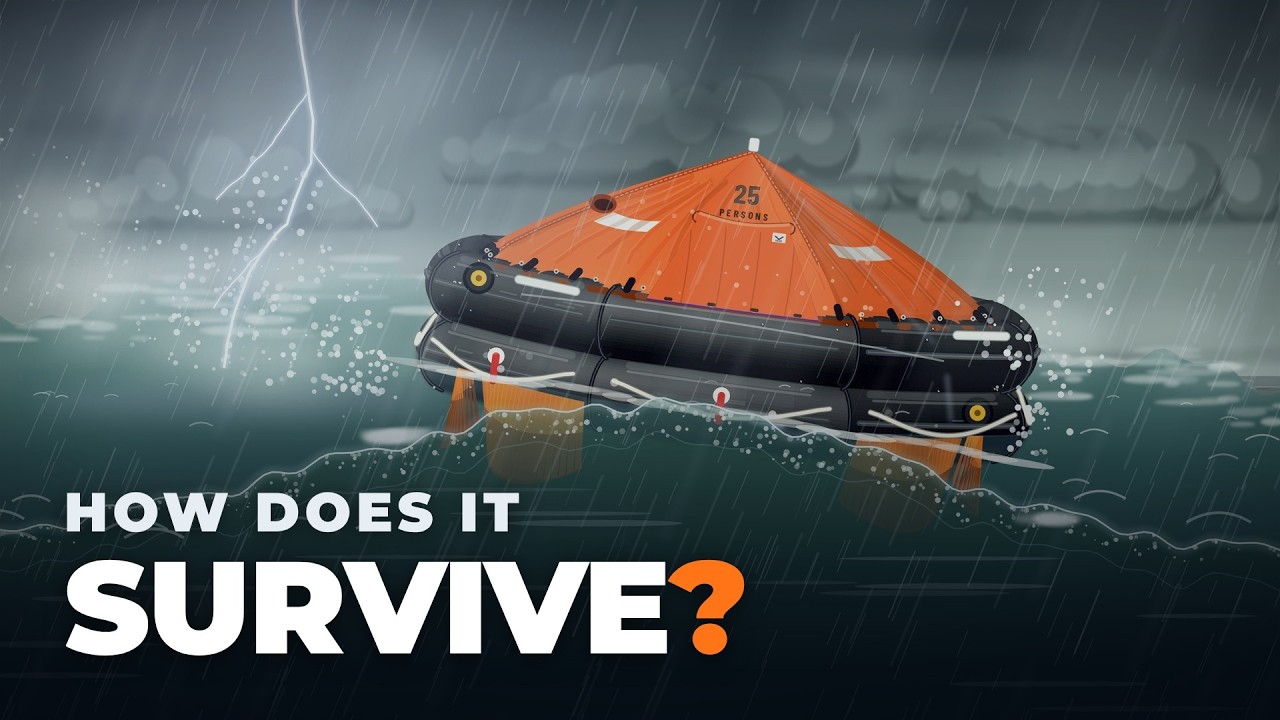
How is a liferaft built – and why is every detail there? Before a new liferaft design is allowed on board a ship, it has to survive an 18-metre drop into the sea and still inflate and work. In this video we take an inflatable liferaft apart, piece by piece: the container, the buoyancy tubes, the self-erecting canopy, the lights, the ballast pockets, the entrances and the floor. Every one of these details is a requirement of SOLAS and the IMO Life-Saving Appliances (LSA) Code – and many of those rules exist because of one night in 1912. At the end: the approval tests every life raft has to pass, and why your liferaft must be serviced every year. In this video: • Why does a liferaft container have to float? • How fast must a liferaft inflate – and why does it always land the right way up? • What happens if one of the tubes is torn? • Why are liferafts orange? • What keeps a light raft from flipping over in a storm? • How many people can a liferaft really carry? • What does Titanic have to do with it? • Which tests must a new liferaft survive before it's allowed on a ship? Based on SOLAS Chapter III, the IMO LSA Code (Chapter IV – survival craft) and the IMO recommendation on testing of life-saving appliances. For general education – on board, always follow your ship's SMS, the manufacturer's manual and your officers' instructions. #liferaft #SOLAS #maritimesafety

When a ship sinks too fast for anyone to launch the liferaft, the raft has to do it by itself. This animation shows exactly how: the hydrostatic release unit, the weak link, the painter line, the inflation and what happens in the first minutes on the water. We also look at the real case of the scallop dredger Joanna C (2020): a hydrostatic release that worked, and a liferaft that still never reached the surface. What went wrong, what changed afterwards, and the 10-second check you can do every time you pass a liferaft station. Source for the case study: MAIB investigation report on the loss of the scallop dredger Joanna C. This video is for general awareness and training support. Always follow your vessel's procedures, the manufacturer's instructions and your flag state requirements. #liferaft #maritimesafety #seafarer

Some of the biggest waves on Earth are invisible — up to 170 metres tall, taller than a 50-storey tower. And the ship sailing above feels nothing. They form in the Luzon Strait between Taiwan and the Philippines. Twice a day, the tide pushes the ocean over two underwater ridges and drags down the thermocline — the sharp boundary between warm, light water on top and cold, heavy water below. When the tide eases, that dip is released and steepens into a train of giant internal waves that travel hundreds of kilometres west across the South China Sea. At the surface the sea rises by less than an inch, but radar satellites can see them from space as bright bands of ripples. When they hit the continental slope, they break, churn the ocean and lift cold, nutrient-rich water up to the coral reefs. #shorts #ocean #internalwaves #science #physics #oceanography #sea

In 1893, Nansen's ship Fram was steaming through perfectly calm Arctic water when it suddenly slowed to a crawl. The engine was at full power, but something invisible was holding her back. Sailors called it "dead water". The cause is hidden beneath the surface: a layer of fresh water lying on top of heavier salt water. A moving ship makes waves on that invisible boundary, and those internal waves steal its speed. We look at Ekman's 1904 experiment that solved the mystery, the 2020 discovery that dead water comes in two kinds, and whether it may have helped decide the Battle of Actium.

in this video I break down how anchoring actually works — from the anchor and chain to letting go, anchor watch, and what happens when an anchor drags. Plus the real story of the Pasha Bulker, driven ashore in a storm off Newcastle, Australia, in 2007.

This animated guide explains MARPOL Annex III (Annex 3): the international rules for harmful substances in packaged form carried by ships. What happens when a container of dangerous chemicals falls off a ship? Who decides how it must be packed, marked and stowed — and what stops it from being dumped into the sea? We follow one drum of marine pollutant from the warehouse to the sea and go through all 8 regulations: application, packing, marking and labelling (the marine pollutant mark), documentation, stowage, quantity limitations, exceptions and Port State Control. You'll also see how Annex III works together with the IMDG Code, why a mark must survive three months in the sea, and what IMO decided in 2026 about plastic pellets lost from containers. Chapters: 0:00 - A container lost at sea 0:36 - MARPOL and its six Annexes 1:53 - Annex III and the IMDG Code 2:56 - Regulation 1 – Application 6:24 - Regulation 2 – Packing 7:32 - Regulation 3 – Marking and labelling 11:01- Regulation 4 – Documentation 13:49 - Regulation 5 – Stowage 15:44 - Regulation 6 – Quantity limitations 16:52 - Regulation 7 – Exceptions: no jettisoning, losses overboard 18:52 - Regulation 8 – Port State Control 20:08 - Plastic pellets (IMO 2026), summary and what's next Based on MARPOL Annex III and the IMDG Code (Amendment 42-24). For education only. Always follow the current regulations, company procedures and flag State requirements. #MARPOL #Shipping #MarinePollution

This video explains the International Ship and Port Facility Security Code (ISPS Code): why it was introduced after 9/11, how ships and ports are protected today, and how maritime security works. We will explore the legal framework of the Code, which is a mandatory requirement under Chapter XI-2 of the SOLAS Convention. You will learn about its two-part structure: Part A, which contains mandatory requirements, and Part B, which provides guidance on how to apply them in practice. You will clearly understand: - What the ISPS Code is And Why It Is Mandatory Under SOLAS ? - How Maritime Security Changed after September 11 - The Structure of The ISPS Code (Part A and Part B) - Duties of Ship Security Officer (SSO), Company Security Officer (CSO) and Port Facility Security Officer (PFSO) - Ship Security Levels 1, 2 and 3 - Access Control, Gangway Watch and Restricted Areas - Ship Security Plan (SSP) and Ship Security Assessment (SSA) - Ship Security Alert System (SSAS) - Drills, Training and Port State Control inspections Timelink: 00:00 - ISPS Code - From Safety to Security 02:40 - Origins of ISPS Code 04:03 - ISPS Code Structure 04:40 - SSO - Ship Security Officer 05:36 - CSO - Company Security Officer 06:08 - PFSO - Port Facility Security Officer 06:56 - ISPS Code - Ship Security Levels 1, 2, 3 08:54 - Ship Security Assessment (SSA) & Ship Security Plan (SSP) 10:45 - ISPS Code - Certification - Ship Security Certificate 11:11 - ISPS Code - Summary ~~~ #maritimesecurity #ISPSCode #security #shipsecurity

In this video, I explain how a Search and Rescue Radar Transponder (SART) helps rescuers locate ships and liferafts at sea using radar, and why it is a mandatory SOLAS Lifesaving Device Every Ship MUST Have! Modern maritime search and rescue relies on technologies that most people never see. Radar, SART, EPIRB are used by ships, helicopters and rescue coordination centers to find survivors and vessels in vast ocean areas, even in poor visibility and heavy weather. 00:00 – What Is a SART and How Ships Are Found at Sea 00:54 – SART vs EPIRB: Ship Emergency Equipment Explained 01:23 – Where SART Is Located on a Ship and How to Deploy It 02:08 – SOLAS Requirements: Mandatory Ship Emergency Equipment 02:28 – Which Radar Detects SART: X-Band vs S-Band 02:53 – How Ships Are Found at Sea: SART Signal on Radar 03:37 – SART Detection Range in Maritime Search and Rescue 04:12 – Why SART Signals Can Be Weak or Blocked 04:43 – Best Radar Range for SART Detection 05:05 – Radar Settings for SART Detection (Step-by-Step) 05:51 – Radar Side Lobes and Their Effect on SART Detection 06:16 – How to Test Ship Emergency Equipment: SART Testing 06:41 – SART Battery Life and Operating Time Explained 07:19 – SART Design and SOLAS Performance Standards 07:58 – Using Radar Reflectors with SART: What to Know 08:20 – AIS-SART Explained: Modern Maritime Search and Rescue For additional information: - IMO SN/Circ. 197 - OPERATION OF MARINE RADAR FOR SART DETECTION -- Recommendation ITU-R M.628-5 - Technical characteristics for search and rescue radar transponders --- IMO RESOLUTION MSC.510(105) - PERFORMANCE STANDARDS FOR SEARCH AND RESCUE RADAR TRANSPONDERS ---- IMO RESOLUTION MSC.246(83) - ADOPTION OF PERFORMANCE STANDARDS FOR SURVIVAL CRAFT AIS SEARCH AND RESCUE TRANSMITTERS (AIS-SART) FOR USE IN SEARCH AND RESCUE OPERATIONS #SART #GMDSS #searchandrescue #MaritimeSafety #SOLAS #ShipSafety #LifesavingEquipment

What is a SART and how does it work? In this video, we explain everything you need to know about the Search and Rescue Radar Transponder used on ships and liferafts for maritime emergencies. 00:00 - What is a SART and Why It’s Used on Ships 00:54 - SART vs EPIRB – Key Differences 01:23 - Where to Store and How to Deploy a SART 02:08 - How Many SARTs Are Required by SOLAS 02:28 - What Radar Can Detect a SART Signal 02:53 - How SART Appears on a Radar Screen 03:37 - SART Detection Range – How Far It Reaches 04:12 - What Can Block or Weaken a SART Signal 04:43 - Best Radar Range Settings to Find SART 05:05 - How to Set Up Radar to Detect a SART 05:51 - Radar Side Lobes – What They Are and Why They Matter 06:16 - How to Test a SART Properly 06:41 - SART Battery Life and Operating Time 07:19 - SART Design and Durability Standards 07:58 - Can You Use Radar Reflector and SART Together? 08:20 - AIS-SART vs SART – What’s the Difference? For additional information: - IMO SN/Circ. 197 - OPERATION OF MARINE RADAR FOR SART DETECTION -- Recommendation ITU-R M.628-5 - Technical characteristics for search and rescue radar transponders --- IMO RESOLUTION MSC.510(105) - PERFORMANCE STANDARDS FOR SEARCH AND RESCUE RADAR TRANSPONDERS ---- IMO RESOLUTION MSC.246(83) - ADOPTION OF PERFORMANCE STANDARDS FOR SURVIVAL CRAFT AIS SEARCH AND RESCUE TRANSMITTERS (AIS-SART) FOR USE IN SEARCH AND RESCUE OPERATIONS #sart #gmdss #searchandrescue

Why are immersion suits so important, and what role do they play in survival in harsh marine conditions to avoid hypotermia? In this video, we will thoroughly explore how immersion suits work and why they are considered a critical element of rescue at sea. Learn how these suits protect against icy water and why their use is so important. We will examine situations where the use of immersion suits could have saved many lives but was unavailable for certain reasons, leading to significant tragedies. Why is it crucial to monitor the condition of immersion suits? How should you properly check the condition of immersion suits according to international SOLAS Regulations? What could happen if your suits are found to be non-compliant with required standards? We will discuss all of this in the video. https://youtube.com/shorts/qga0vVc5rrw?feature=share Timelink: ~ Intro: 00:00 - Intro 00:25 - Number of Losses 01:04 - Hypothermia at sea 01:40 - Why immersion suits are required? 02:37 - Immersion suits main advantages 03:23 - Types of Immersion Suits 03:56 - Immersion suits buoyancy explained 04:21 - Immersion Suits real-life failures 05:56 - Immersion Suits Onboard Locations 06:13 - Immersion Suits Inspections and Maintenance 07:50 - Immersion Suits Air Pressure Test 08:37 - Outro ______________________________________________________ Source of Information: ~ LSA CODE ( International Life Saving Appliance Code ) ~~ CHAPTER 2 - PERSONAL LIFE-SAVING APPLIANCE ~~~ 2.3 - IMMERSION SUITS ______________________________________________________ IMO Circulars - Maintenance and Inspections of SOLAS Immersion Suits ~ MSC.1-Circ.1047 - Guidelines For Monthly Shipboard Inspection Of Immersion Suits And Anti-Exposure Suits By Ships Crew (Secretariat) ~ MSC.1-Circ.1114 - Guidelines For Periodic Testing Of Immersion Suit And Anti-Exposure Suit Seams And Closure. ______________________________________________________ ~ Republic of the Marshall Islands - MARINE SAFETY ADVISORY No. 09-21 ~ Republic of the Marshall Islands - MARINE SAFETY ADVISORY NO. 18-19 ______________________________________________________

Today, we're focusing on MARPOL Annex I – specifically the requirements for the machinery spaces of all ships. This video covers Chapter 3 - Regulations 12 to 17, which outline essential rules for preventing oil pollution from ships. By the end of this video, you’ll have a clear understanding of the construction, equipment, and operational control measures outlined in MARPOL Annex I for all ships, which are designed to prevent oil pollution at sea. We'll dive into Part A - Construction, discussing: Regulation 12 – Tanks for Oil Residues (Sludge) Regulation 12-A – Oil Fuel Tank Protection Regulation 13 – Standard Discharge Connection Next, we'll look at Part B - Equipment, focusing on: Regulation 14 – Oil Filtering Equipment Finally, in Part C - Control of Operational Discharge of Oil, we'll cover: Regulation 15 – Control of Discharge of Oil Regulation 16 – Segregation of Oil and Water Ballast and Carriage of Oil in Forepeak Tanks Regulation 17 – The Oil Record Book, Part 1 By the end of this video, you'll have a solid understanding of how these regulations work together to prevent oil pollution and ensure cleaner operations at sea. Let's dive in and explore these critical rules that help keep our oceans protected! Timelink: 00:00 - Intro 00:59 - Marpol Annex 1 - Regulation 12 - Tank For Oil Residues 01:55 - Two Exceptions For Sludge Tank Connections To Bilge System. 02:41 - Marpol Annex 1 - Regulation 13 - Standard Discharge Connection 04:13 - Marpol Annex 1 - Regulation 12 - A - Oil Fuel Tank Protection 04:45 - Fuel Oil Tank Protection - Vertical Safe Distance 05:29 - Fuel Oil Tank Protection - Horizontal Safe Distance 06:44 - Marpol Annex 1 - Regulation 14 - Oil Filtering Equipment 07:00 - Oil Filtering Equipment Requirements for ships between 400 and 10000 GT 07:21 - Oil Filtering Equipment Requirements for ships more than 10000 GT 07:40 - Oil Filtering Equipment Exeptions ( Floating Hotels & Storage Vessels Etc.) 08:00 - Marpol Annex 1 - Regulation 16 - Segregation Of Oil and Water Ballast 09:10 - Marpol Annex 1 - Regulation 16 - Carriage Of Oil In Forepeak Tanks 09:31 - Marpol Annex 1 - Regulation 15 - Special Areas 11:48 - Marpol Annex 1 - Regulation 15 - Control of Discharge of Oil - Outside of Special Area 13:09 - Marpol Annex 1 - Regulation 15 - Control of Discharge of Oil - Inside of Special Area 14:39 - Marpol Annex 1 - Regulation 17 - Oil Record Book - Part 1 - Machinery Space Operations 15:09 - Oil Record Book - Part 1 - List of Items To Be Recorded #marpol #annex1

What is MARPOL, and why is it so important? Today we'll dive into the MARPOL Convention and its Annexes to explore how they protect the marine environment from water pollution and other critical environmental issues. What is MARPOL, and why is it crucial for protecting our marine environment? MARPOL, or the International Convention for the Prevention of Pollution from Ships, is a global framework designed to tackle various types of pollution caused by maritime activities. In this video, I'll explain what MARPOL is, its history, and the key regulations outlined in its six annexes: MARPOL Annex 1 (Oil Pollution), MARPOL Annex 2 (Noxious Liquid Substances), MARPOL Annex 3 (Harmful Substances), MARPOL Annex 4 (Sewage), MARPOL Annex 5 (Garbage), and MARPOL Annex 6 (Air Pollution). We'll dive into how the MARPOL Convention was introduced to address environmental pollution, including water pollution, air pollution, and the growing issue of plastic pollution. You’ll also learn how waste management and pollution control measures are implemented to protect our ocean and aquatic resources from degradation. Throughout the video, I’ll discuss real-world pollution incidents that led to stricter regulations under MARPOL annexes, how ships are certified and inspected for compliance, and the laws for the environment that help preserve marine ecosystems. By the end of the video, you'll have a better understanding of the MARPOL annexes and how these regulations contribute to protecting the environment. Let’s take steps together to reduce the pollution of water resources and make our maritime industry more sustainable. 00:00 - Introduction: What is MARPOL? 01:13 - Structure of MARPOL: Annexes 1 to 6 02:43 - Goals and Importance of MARPOL 03:10 - Certification and Ship Inspections 03:39 - Pollution Incidents, Regulation and Responsibilities 04:32 - Importance of MARPOL Compliance Other video: Marpol Annex 1 - Regulations 12, 12-A , 13 , 14 , 15, 16, 17 ▶️🎬 https://www.youtube.com/watch?v=mBpHtQDcYT8&t=57s #marpol #oceanpollution

In this video, we witness the dramatic collision between the tankers Lyric Magnolia and Aligote in the Suez Canal's Great Bitter Lake. Navigation errors led to this shocking incident, and the footage provides clear evidence of the impact. #collision #suezcanal #shipping