Những video mới nhất

A couple of weeks after the Falmouth race Shane and I had another weekend race, this time the 20 miles to Fowey on Saturday and back to Plymouth on Sunday. Fewer boats this time, 8 multihulls and 25 half-boats. The conditions at the start in Plymouth couldn't have been more different from the previous race! Not a breath of wind, not a cloud in the sky and hot! Multihulls "started" first, but most didn't actually sail, rather they drifted over the line. In fact the last multihull to start took 15 minutes to cross the line. We were one of the 4 lucky ones who got a gust just at the right time, so we were able to pull a mile or so ahead of the fleet within the first 20 minutes. Which certainly proves that calms can be a slow boat benefit! As we passed the breakwater a light WSW wind picked up, so it was then a beat to Fowey. Unfortunately there was just too much wind for our screecher, but not really enough for the genoa alone. Although the trimarans went out to sea, we decided to compromise and kept further inshore, but even so, well to seaward of the monohull fleet. It didn't really pay off - the out to sea route was the best, but we didn't realise that until too late. Still, we were pretty happy with our 3rd place. Anchoring is no longer allowed in Fowey, so we all rafted up on some of the smaller pontoons and dinghied ashore for a meal. Next morning the wind had increased to 12-15 knots and we prepared for a fast, downwind sail back to Plymouth - for once conditions that would favour Sagitta. Having said that, we weren't quite fast enough in those conditions to "hot it up" and gybe downwind as the others did. Instead we used "tweaker" lines on our asymmetric so we could pull the tack to windward and sail with the wind further aft. It certainly paid off for us compared to the others who, although faster, sailed further, so the whole multihull fleet stayed in sight for much of the race. Mind you, with only two on board we found gybing quite a challenge - more practice definitely needed! So for the first 20 miles it was a no fuss, no frustration, no drama race. But that changed as we headed into the Sound and past the breakwater. Plymouth is not just the biggest naval port in Europe but also has very busy commercial docks. So it wasn't a great surprise to see a Portuguese warship leaving port as we were sailing in. They were probably not expecting to see an armada of 30 yachts under spinnaker spread across the channel! The escorting police boats started "blue lighting" and hailing the yachts to try and get them to gybe away. Luckily we were just far enough ahead to keep clear without a major course change. To compound the problem the ferry from France came into port at exactly the same time. They had to wait in the middle of the Sound until not only the first warship cleared the main shipping channel, but also the second one, this time from Norway. Fortunately only one yacht ended up head to wind with spinnaker flapping while trying to avoid all three ships. Hissy Fit and Gordano Goose are both 40% faster than Sagitta, yet were less than 30 minutes ahead of us at the finish, as the results show. On corrected time we had a 3rd and a 2nd. All in all, not bad results for a "proper" cruising boat. After all, we were the first boat carrying a dinghy in davits, BBQ and central heating!
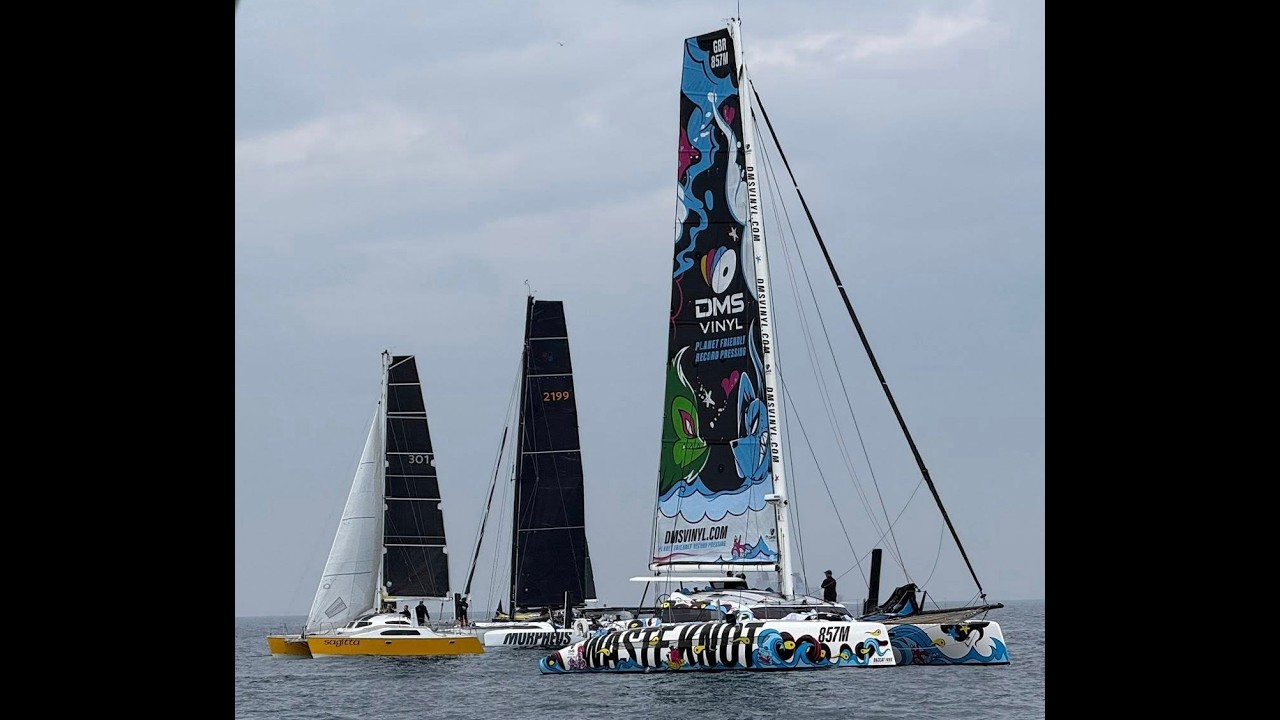
The 30ft Sagitta catamaran was designed as a performance cruiser, or cruiser/racer if you prefer. So throughout it's 34 year life we have raced it, while it's also been cruised far and wide (currently the furthest it's sailed was to Trieste in Italy) Despite some terrible weather so far this year we have already had several short cruises and also had success in a few coastal races. The first of these was the "Falmouth Triangle" race, the traditional season opener in Plymouth. We first raced it 40 years ago in our Banshee catamaran when we were the fastest multihull and beat all but one monohull round the course. But times move on and Sagitta is now almost the slowest MOCRA rated multihull. Many local boats are 40% faster, which means we rarely see them after the race starts. This years triangle was no exception. There were 14 multihull entries, about a 1/3rd of the fleet, the first leg is roughly 40 miles - from Plymouth to Falmouth. Even under spinnaker and with 4 experienced crew on board, we soon dropped back, with the leaders out of sight ahead. Actually, since it was a misty day that turned to heavy rain for the last 3 hours, that wasn't surprising! Had we been cruising I'm sure we'd have all sat inside and sailed under autopilot. But as it was we got very wet and a bit bored sailing all alone in the murk. So imagine our surprise, as we neared Falmouth, to see more and more boats appearing only just ahead! Some should have finished literally hours earlier, so not unexpectedly, when we arrived we learnt we had won the first leg on handicap. Sadly that success wasn't repeated on the next two legs. The race to Fowey, about 20 miles east of Falmouth, was a light wind beat, but unfortunately we were unable to use our masthead screecher due to halyard problems. So we finished 5th. Once in Fowey Peter went up the mast to, temporarily, sort it out. As he's only 25 he doesn't really need a bosun chair - he just monkeys up the forestay. Which sure makes it easier for the winching crew! By now the sun had come out and we had another light wind beat back to Plymouth. We made a real lash up of twin barber-haulers for the screecher, but we now know how to set it properly. Even so, it wasn't too successful, another 5th, mainly because we couldn't really agree on tactics and in the end made too many compromises. So we came third overall.

There is something seriously wrong with the weather. We just had a 3 day holiday weekend - yet it was hot, a light breeze blowing and not a cloud in the sky! So Jetti and I decided to take a gentle cruise in our 30ft Sagitta catamaran to Hope Cove, about 15 miles east of or mooring in Plymouth. We just drifted along, together with a whole variety of different boats. No drama or excitement, so this video just shows the deck layout and some of the interior of our boat. Hope Cove was crowded when we got there so, unusually, we had to anchor in 30ft of water - normally we try for under 10 ft. And very glad we were not on a monohull, they were all rolling rhythmically in the SW swell. Next day we sailed back to Plymouth, a bit more wind so touched 6+ knots at times. Apart from the lack of roll, the other big advantage of a multihull is that we have all round vision when sitting inside (we go "inside" not "down below" on catamarans) Sunday night was spent at one of our favourite anchorages, up the Lynher river, with obligatory BBQ. Then home again on Monday. If only all sailing was like that! As always, no audio on this short video. More on the Sagitta catamaran here https://sailingcatamarans.com/index.php/designs-2/3-25ft-to-30ft-catamarans-designs/171-sagitta
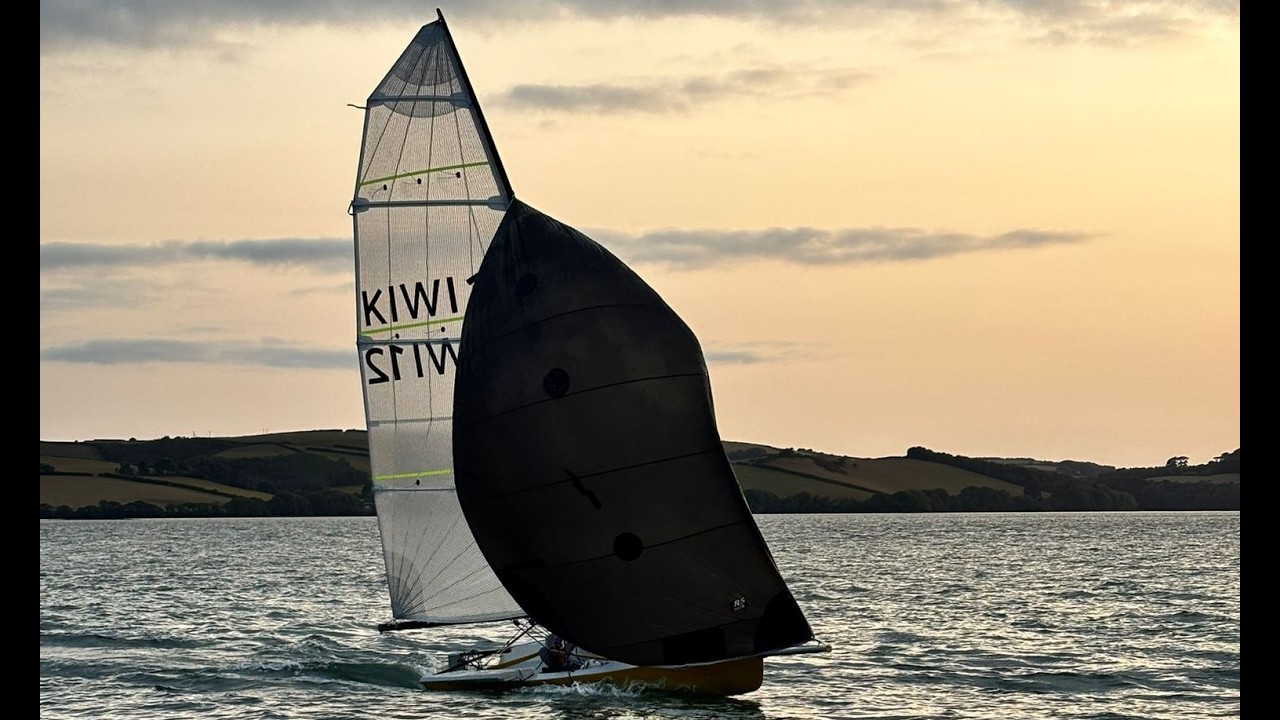
As many know, I don't just design and sail multihulls. I am also a keen dinghy sailor, having been racing in a huge variety of different singlehanders for over 60 years. For the last 5 years or so I've been racing a singlehander with an asymmetric spinnaker - as seen in the heading photo. But as I'm now well into my 70s I found it a bit too challenging in winds over 15 knots. I bought a 13ft Solution dinghy at the end of last summer. This video is on one of my early sails, before I had got used to the boat and had set it up as I wanted. I hadn't taken any video from a dinghy for a few years and so this one was a bit of a test for a suitable setup. It wasn't great having the mount by the shrouds, even though it was out of my way. So I had to handhold the camera for a while. Anyway, at least it shows you my sailing/racing area, near the mouth of the river Tamar in Plymouth. More on the Solution here http://www.solutionclass.org/ And on my club here https://www.tmsc.org.uk/page/dinghy-sailing-at-tmsc
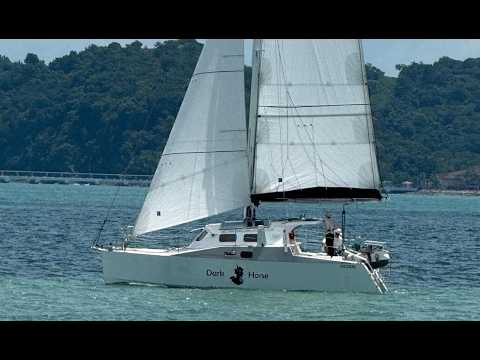
We spent a few weeks in January touring SE Asia. At the end of our trip we were in Phuket, Thailand and by coincidence so too were Nigel and Suzanne on their Tamar 31 catamaran, Dark Horse. They are very experienced sailors and have a very nicely built boat. They kindly invited me for a sail and we had a great time sailing round the nearby islands. I found it very different to the Caribbean, which is effectively a lee shore after 2000 miles of trade winds and accompanying swells. Whereas off Phuket there was just a wind blown chop and much lighter winds. It also didn't rain, in fact there were not even the "trade wind" clouds we were used to in the West Indies. The downside was that it got very hot and the rigid bimini was essential, even though it did somewhat reduce the view of the sails. One of the few modifications made on Dark Horse. We think there are a lot of multihulls in the UK, but anchored in the bay we counted 23 multihulls and 31 monohulls. And that number excludes the 30+ day charter cats operating out of the marina. More on the Tamar 31 here https://sailingcatamarans.com/index.php/designs-2/5-catamarans-over-40ft/480-tamar-31 As always no audio on this short video

For my birthday treat this year I sailed our Chat 18 catamaran for the first time since before Christmas. A clean bottom and new antifouling did wonders for both speed and manouverability! I only sailed for a couple of hours, in part because the weather was worsening, but mainly because the tide was dropping and I needed to get back onto our beach mooring. It was a great sail, just touching 8 knots at times. In fact the whole area shown in this video dries out at low tide - it's called "West Mud" for a reason! More on the Chat here https://sailingcatamarans.com/index.php/designs-2/2-catamarans-under-25ft/475-chat-18-daysailing-catamaran and lots more videos on my Youtube Channel And keep an eye out for a major Chat boat test that will appear shortly in Practical Boat Owner, the UK's biggest boating magazine! As always, no audio on this short video

Everyone enjoys seeing dolphins round their boat. And it seems catamarans attract more dolphins than monohulls. Presumably because the two bows are more fun to play with - and yes dolphins definitely play on the bow waves. We've seen two swim fast under the bridgedeck from port stern to starboard bow and vice versa, crossing underneath and seeing how close to the bow they could get. And we've seen the other dolphins clearly laughing at the one who hit our bow when cutting it too fine. That didn't happen this time, but here's a recent video taken when sailing our 30ft Sagitta catamaran from Fowey to Plymouth. Unusually for the English Channel it was clear, flat water so we could watch them easily.

Patrick has been sailing his home built plywood Strike 20 in France for many years (see his earlier videos) He just reported "Some refitting of my Strike 20 this year! New 20' outriggers from a Nacra 6.0 replacing the F18 ones I used previously. New paint for the mainhull, Tornado spinnaker, electric motor with LiFePo4 battery. New crew from a Tornado. I am definitely getting too old (79 next month !)." You can see more on the Strike 20 here https://www.sailingcatamarans.com/index.php/designs-2/27-trimarans-under-25/433-strike-20

The Cornish town of Fowey, about 20 miles west of Plymouth, has long been hugely popular with cruising sailors. We go there several times a year. However we hadn't been up the river itself for many years, so last week seemed a good opportunity to do so. It's crowded with moorings near the mouth, and has a shallow, twisting channel further inland which makes it all somewhat challenging. So we wanted to concentrate on navigation on the trip upriver. Thus this video starts at St Winnow and its famous water front church, and then makes it way back down to the sea. I have been further upstream (it's possible to get to Lostwithiel) but the river narrows very quickly - too narrow to turn a 30ft x 20ft catamaran round, we didn't want to back out! The upper reaches are basically empty, no moorings, no waterfront houses. That all changes at Golant, a village just north of Fowey. Even though most of it dries out at low water it's still full of small boat moorings. A mile further downstream and, somewhat bizarrely for what seems a sleepy Cornish river, we motored past the commercial docks. Usually exporting china clay, from Cornwall's biggest industry. Turning the last bend we reached Fowey harbour and the town and picked up a mooring. But not before passing the small car ferry and then the house once owned by famous author Daphne de Maurier (of Frenchmans Creek, Jamaica Inn etc fame) In the evening we watched the local dayboats - the Troy class - race in a fading wind. Totally ignoring the china clay ship leaving port. It looked huge going out, but nothing compared to the cruise ships we have seen in the river! As always, there is no audio on this short video (you wouldn't like my choice of backing music, nor the constant noise of an engine). Having said that, the appropriate sound track would of course be something by Oasis, as "Definitely Maybe" was recorded in a water front studio just north of Golant. Yes I know, I should have filmed it as we passed.

This video is an extract of a longer video of Uli's latest trip, primarily to show what its like sailing a small multihull at speed in strong winds (comfortable and dry is the answer!) Uli writes: During the summer of 2024 I made another long trip in my Eagle. From Germany I sailed to Norway (Egersund) and then further on, to Unst (Shetland) via Lerwick, round Cape Wrath to Kinlochbervie (Scotland). Sailing up wind south through The MInch and The Sea of Hebrides and, later, The Irish Sea was not really a joy. Throughout August cyclones crossed these area nearly every day. So small windows of opportunity and strong southerly winds dictated the trip. From Greystones (a harbour I do not recommend), near Dublin, to Fishguard I sailed up wind. The wind blew between 28 and 30 knots for more than six hours.(I lifted the daggerboards a little.) The wave got high - between 4 and 5 m - and stipply with white crests. In this, my experience and the weather reports are the same. The trip overall took less than ten an half hours. It was very wet. The Eagle sailed very well. From Fishguard to Lands End I again sailed up-wind, but in more moderate winds - force 4 to 5 - averaging between 8.5 - 9 knots. All the way I put my faith in the Eagle and the new autopilot. I sailed singlehanded about 2.400 nm, and I got a little bit more know-how about how to sail a multihull. You can see more of the Eagle here https://www.sailingcatamarans.com/index.php/designs-2/2-catamarans-under-25ft/455-eagle-24 and a video of a previous trip here https://www.youtube.com/watch?v=IpX_fEAYLFU

This video was taken on my 7th trans-atlantic crossing, from the Canaries to Prickley Bay, Grenada - via the Cape Verdes - in late 2024. I was on board a Dutch 11m Nimble catamaran with two other crew. We generally had light winds and calm seas, in fact gentle enough so that on most days I could have sailed my dinghy. My first three trans-atlantics were with boats without autopilots, so we had to hand steer all the way. These days it's very different, there's no need to steer (nor, of course, navigate by sextant) unless something goes wrong with the autopilot or electronics. So this was something of a boring trip - reflected in the video I guess. With no real stress there was plenty of time for reading and relaxing. Thus the video shows no exciting moments, because there weren't any - which is as it should be when ocean cruising. As always, there is no audio on this short video. You can read more about this trip, see my designs and much more, all on my website www.sailingcatamarans.com

As always at this time of year I video the multihulls in the storage yard at the Multihull Centre, Millbrook, Cornwall, UK. In the video you can see several of my designs - 4 Sagittas, a Flica, a Strider Club and a Duo. And also: Several Prouts, Dazcats, Lagoons, Fountaine Pajot, Kelsall, Outremer, Catana, Shuttleworth, Grainger, Freebird, Iroquois, Hirondelle, Heavenly Twins, Ocean Winds, Twins 36, Le Rouge, Marples, Dragonfly, Farrier. And a number of designs unknown even to me. (And three monohulls, looking very out of place) You can also see lots of empty space, that's because there are at least 16 more multihulls to be lifted out. So if you are thinking about buying a multihull the Multihull Centre is a great place to go, especially in the winter. https://www.multihullcentre.com/multihull-centre

We try to get out on the water whenever we can, either sailing a dinghy or a catamaran. But sometimes, as on this trip, sails would have no use. So we motored our Chat 18 instead. Once again up the river Lynher, this time past Forder and on further west, to Dandy Hole. This is a very popular anchorage as it has deep water even at low tide. But we were able to anchor for a lunch stop in the shallows. Hard to believe we were only two miles from the largest naval dockyard in Europe! We use OpenCpn on our old OLPC XO laptop as a chart plotter - we've been using it like this for 15 years. All the world's charts on one SD card. USB GPS. Splash proof screen, 12v supply, daylight viewing. Running on Linux. As we motored along past Antony and Whacker Quay we discussed fitting a bimini. "no need" we said "it's never that hot in England". After lunch we said "let's go home, it's too hot here". So we did. Fitting a bimini has now moved further up the "must do" list! As always, no audio on this short video More on the Chat 18 here https://www.sailingcatamarans.com/index.php/designs-2/2-catamarans-under-25ft/475-chat-18-daysailing-catamaran and the similar Skoota 18 here https://www.sailingcatamarans.com/index.php/designs-2/6-powercats/489-skoota-18

Here is the last (for now) video from the Douarnenez Boat Festival. This time taken over several days from the shore. I was there helping out on the (DCA) Dinghy Cruising Association stand, see here for more https://www.dinghycruising.life/ (as always, no audio on these short videos)

Another video from the Douarnenez Boat Festival. This time taken from on board Mark's 11ft Gull dinghy. A huge variety of boats, old and new, all out sailing on what was the best day of the festival. As always, no audio on this short video

At long last here is a "walkthrough" of the Chat 18 catamaran. Slightly modified, with wheel steering for the outboard. Which makes it pretty much the same as the Skoota 18. Obviously the latter doesn't have the keels and also has a slightly deeper transom. I apologise for the poor paint job - it hasn't been touched since launching 4 years ago. The engine uses the "old fashioned" rope steering rather than a push pull cable - mainly because I had most of the bits in my spares box. It's a 6hp which gets us to 7 knots but we usually cruise at around 6. Mounted on a lifting bracket - on the Skoota 18 its fitted in a nacelle. The cockpit has very comfortable seats, long enough to lie down and sleep. So a cockpit tent would mean a couple and two young children could (just) sleep on board. For privacy the forward windows are fake, the aft cabin entrance is a roll up curtain rather than washboards, which are always a pain to stow when removed. Two deep cockpit lockers for sail bags etc. Plus several smaller ones for fuel tanks, pumps, spare rope etc. The cuddy is similar to a two person backpacker tent. 2.4m wide and 1.2 m fore/aft (8ft x 4ft) means there's room for a small galley and a double bunk. Although only a single airbed is on board, plus the rolled up cockpit cushions. Headroom is limited of course - 1100mm, 40in - just as in a tent. Apart from the space inside it also gives a lot of protection for the crew in the cockpit - no spray on board! More on the Chat 18 here https://www.sailingcatamarans.com/index.php/designs-2/2-catamarans-under-25ft/475-chat-18-daysailing-catamaran and Skoota 18 here https://www.sailingcatamarans.com/index.php/designs-2/6-powercats/489-skoota-18 (as always, no audio on this short video)

I helped out on the Dinghy Cruising Association stand at the 2024 Douarnenez Boat Festival in France. I made several short videos of the event, and this is the first: There are thousands of people called "Roper" and hundreds of "Ropewalks" in coastal towns and cities around the world. This video shows why they were so named, and how ropes were traditionally made. Obviously this setup is just for demonstrations, as a real rope would be much longer than the 10m/30ft one being made here. Clearly there is a LOT of walking backwards, and co-ordination between the rope winder and the thread twister is essential. The video should be self explanatory so no commentary is needed.

An earlier video showed our Chat 18 being used as a power cat fitted with a 6hp outboard and cruising at 6 knots up a Cornish creek. This video is of the same boat, but taken from the shore. Thus rather too shallow water (under 1m - 3ft), so the stern "sucked" more than usual (thank you Froude) and thus limited speed. Deep water is cruicial for optimum speed on all non-planing power boats. A fairing on the outboard leg (as drawn on my Skoota 18, 20 and 24) is essential for larger engines as otherwise there is too much aeration and drag from the leg. Another job for another time.... You can see more on the Chat 18 here https://www.sailingcatamarans.com/index.php/designs-2/2-catamarans-under-25ft/475-chat-18-daysailing-catamaran and the very similar Skoota 18 here https://www.sailingcatamarans.com/index.php/designs-2/6-powercats/489-skoota-18 (The Skoota has more buoyancy aft and of course no sailing rig, deck gear, nor LAR keels.) (as always, no audio on my short videos)

My Chat 18 sailing catamaran and Skoota 18 powercat are very similar designs, but not actually identical. The Skoota hulls have more buoyancy aft to take the weight of the engine and of course it doesn't have a king post/mast support or keels. We've been sailing our Chat in the Plymouth area for several years but this year decided to use it as a motorboat. That would allow us to cruise to places inaccessible to most sailing boats. We fitted a 6hp outboard (the biggest the existing bracket can take - and anyway there is a 10 knot speed limit in the river Tamar) which gives a near 8 knot speed. We added a simple rope controlled steering wheel. No remote throttle or gear controls as they would be complicated to invent, and it is simple enough to adjust them from the back of the cockpit. The Tamar river and its estuaries hide many gems inaccessible to large boats. So our first trip was up the creek that runs from the Lynher to the small waterfront village of Forder. I've lived on the banks of the Tamar for over 40 years, yet this was first time I've ventured this far inland. There was just room to do a three point turn at the head of the creek. It dries out completely at low water, one reason why only small shallow draft boats are moored to its banks. The other of course is the railway viaduct! A very successful evenings motor. We plan lots more exploring later this summer, including going up the Tavy, which has a fixed 7m high rail bridge at its mouth. From exploring by land we know there's a great waterside pub at Bere Ferrers, and of course Buckland Abbey (home to Francis Drake) at the head of the navigable river. So definitely worth a trip by water. More on the Skoota 18 here https://www.sailingcatamarans.com/index.php/designs-2/6-powercats/489-skoota-18 (As always with my short videos there is no audio.)

It's been a while since I last posted, but here is a short video of Sagitta's first sail of 2024. The forecast was for sun and light winds, we were also promised a warm day. In the event only the "sun" part was correct. The wind was 15-18 knots when we started sailing, but slowly moderated during the afternoon. And it was cold, too cold for Jetti, who stayed in the cabin all day. (When we got home we checked last year's logbook, our first sail in 2023 was nearly a month later and it was also cold). Buying diesel for the central heating is now top of the "to do" list! You will see that, despite sailing at 8 knots+, Sagitta will steer itself for long periods. The "portrait" video was taken by Henry, sailing with friends on a Plymouth University J80 and shows Sagitta's new colour scheme, now back to almost the same colours as it was when first launched, back in 1991. More Sagitta videos to come during the year! You can see more on Sagitta here https://www.sailingcatamarans.com/index.php/designs-2/3-25ft-to-30ft-catamarans-designs/171-sagitta (as always, no audio on my short videos)