Welcome aboard to the our video site for sailors. We are being constantly blasted by scammers and pirates, so registration is invite only
contact@sailorsahoy.com with "Invite". No spam, no newsletters. Just a free account
Şort oluşturmak

Visiting the Šolta, we stayed at the sheltered ‘Mojito Bay’. The name attracted us, that's why ;). The next day we noticed tourist boats in this bay stopped at a specific spot and people started looking at the water, sometimes swimming, but most of the time leaving again. It turned out that there was a shipwreck called ‘Kontesa’ which sank here and could easily be seen just below the crystal clear water! The ship was built in 1943 and served as a cargo vessel during World War II. After the war, it was sold and converted into a passenger ship, carrying tourists along the Croatian coast. Its sinking in the 1980s was due to a storm, and fortunately, all passengers and crew members were rescued safely. Today, the Shipwreck of Kontesa serves as a reminder of the island’s rich maritime history and provides a unique opportunity for visitors to explore and learn about underwater ecosystems. Over the years, the sunken ship has become a habitat for a wide range of marine life, including colorful fish, octopuses, crabs, and sea anemones. So I got my snorkeling gear and getting closer to the area you could see the top of the ship, it was only 1 or 2 meter under the waterline! Gilles filmed me with our waterproof Go Pro camera, while I was swimming towards the shipwreck.
0
0
0
132
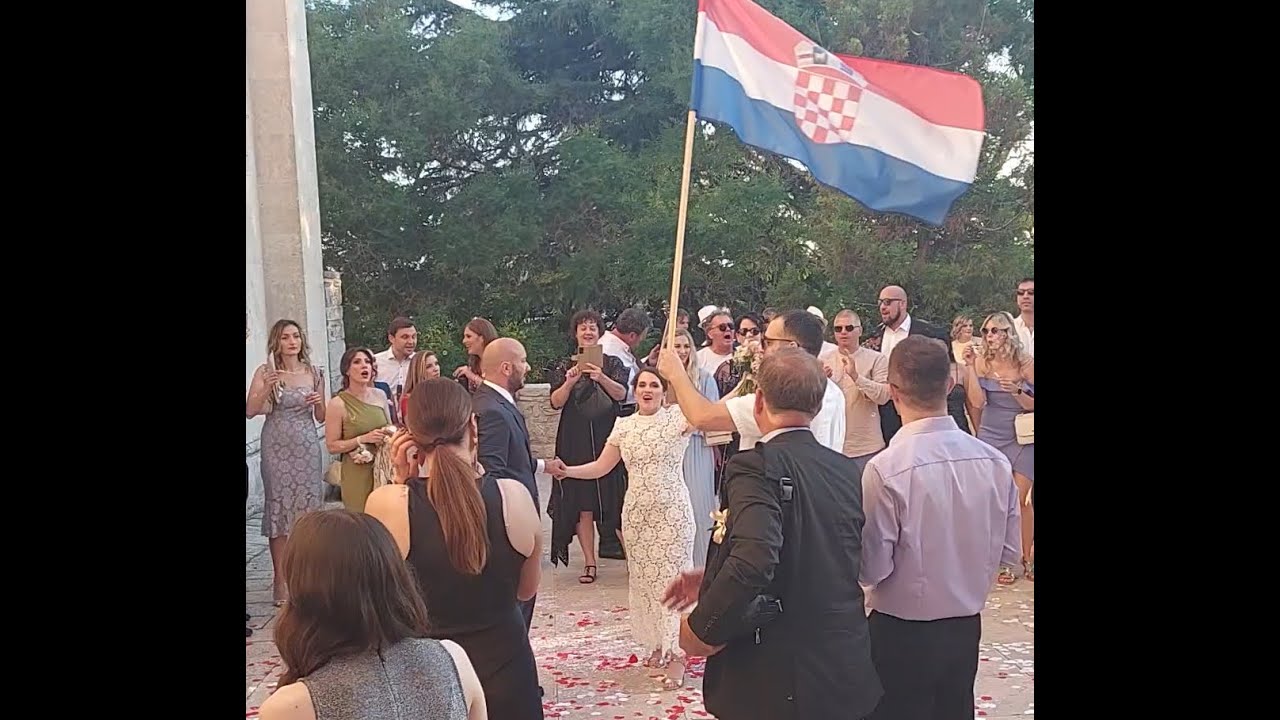
We witnessed a newly married couple coming out of church around 20:00 in the town of Šibenik in Croatia on a Friday night. They danced together to beautiful traditional music. Family and friends stood around them clapping. The tamburica (a string instrument) and folklore dances are popular at weddings. It was fun to experience this exuberant wedding celebration. I think that in the Netherlands you don't see someone waving a Dutch flag and the bride making a cool cheering gesture at the end.
0
0
0
17,080

The Crazy Waters Bridge in Chalkis sits at the narrowest point between Evia and the mainland, where the strait is only about 38 meters wide. Because so much water is forced through this tiny opening, extremely strong currents are created — the reason sailors call it the “Crazy Waters.” The bridge is in the middle of the city and opens only once a day to avoid disrupting the constant road traffic. Boats may only pass at slack tide, the brief moment every six hours when the water is calmest. That’s why sailors often go through at strange times like 1:30 or 3:00 a.m. While waiting, boats are not allowed to tie up along the quay because the turbulence is so strong that it would be dangerous. Instead, everyone must anchor in the bay and wait for instructions from Port Control. We anchored there with about fifteen other boats and waited until slack tide at night. At midnight, Port Control suddenly called all boats in order — we were number three. Passing the bridge in the dark was surreal: strong currents below, quiet city lights above. The bridge didn’t lift; it actually slid sideways into the quay walls, disappearing completely. Once through, we moored safely just 100 meters further in the city. Experiencing this natural phenomenon at night, in such a narrow and powerful channel, was something I will not quickly forget!
0
0
0
3